
Let's talk about one of the most complex, feared, and deeply revered Orisas in the Yoruba pantheon – Obaluaye. If you've been around traditional spiritual circles for any length of time, you've probably heard whispers about this powerful force. Maybe someone mentioned his name in hushed tones, or you've seen his distinctive raffia-covered imagery and wondered what that's all about.
Here's the thing – Obaluaye isn't your typical "love and light" spiritual figure. This Orisa deals in the raw, uncomfortable truths of existence: sickness and health, death and rebirth, the margins of society that most people prefer to ignore. And that's exactly why we need to understand him.
The Many Names of Power
Obaluaye goes by several names, each revealing a different aspect of his nature. You might know him as Babalú-Ayé in the Cuban traditions, Omolu in Brazilian Candomblé, or Ṣọpọna in Nigeria. Each name carries weight, history, and specific cultural understanding.
"Obaluaye" itself translates roughly to "Lord of the Earth" or "Father who owns the world." That's not metaphorical – this Orisa literally governs the earth beneath our feet, the diseases that come from it, and the healing that springs from the same source.
The name Ṣọpọna is particularly significant because it directly references smallpox – a disease that historically devastated communities but also, through surviving it, granted immunity and strength. This duality is at the heart of everything Obaluaye represents.

The Dual Nature You Can't Ignore
Here's where things get real, and where a lot of people get uncomfortable. Obaluaye is both the one who brings disease and the one who cures it. He's the Orisa who can decimate a village with plague, and the same force that performs miraculous healings.
This isn't contradictory – it's profound wisdom about the nature of existence itself.
Think about it: every medicine that heals can also poison. Every immune system that protects you had to learn by encountering threats. Every moment of health is precious precisely because illness exists. Obaluaye embodies this truth without sugarcoating it.
The praise name "Alápa-dúpé" – "one who kills and is thanked for it" – might sound harsh, but it speaks to a deeper understanding. Sometimes what feels like destruction is actually transformation. Sometimes what looks like an ending is really a beginning.
The Straw That Tells a Story
You've probably seen images of Obaluaye covered in straw or raffia from head to toe. This isn't just aesthetic – it's deeply symbolic and rooted in his mythology.
According to tradition, Obaluaye was born covered in sores and lesions. His mother, Nanã, abandoned him on the beach because she couldn't bear to look at his afflicted body. But Yemojá found him and nursed him back to health, teaching him the arts of healing. The straw covering serves multiple purposes: it protects his sensitive skin, it represents the mystery and hiddenness of his power, and it shows that beauty and divinity can exist beneath what society considers ugly or unacceptable.
That last point is crucial. Obaluaye is the patron of the marginalized – those society pushes to the edges because of illness, disability, poverty, or difference. He stands with those who are forgotten, dismissed, or feared.

Traditional Attributes and Symbols
When working with Obaluaye, certain symbols and tools carry special significance:
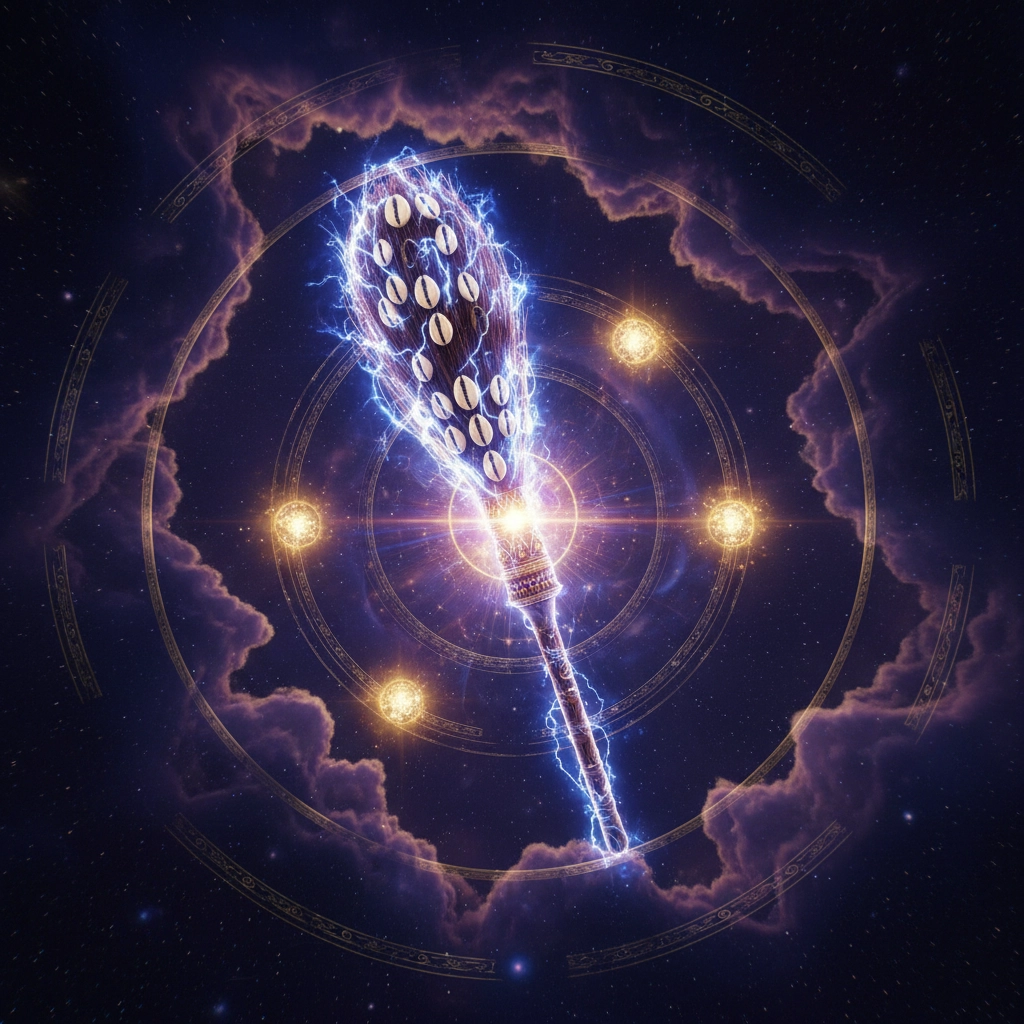
The Xaxará (Ritual Broom): This isn't your everyday cleaning tool. Made from palm fronds and decorated with cowrie shells and beads, the xaxará is both a symbol of Obaluaye's authority and a practical tool for spiritual cleansing. It sweeps away illness and negative energy.
Cowrie Shells: These represent both wealth and the connection between the physical and spiritual worlds. In Obaluaye's context, they often symbolize the preciousness of health and the value of life.
Colors: Red, black, and white dominate his aesthetic. Red for the blood of life and sacrifice, black for the mystery and depth of transformation, white for healing and purification.
Offerings: Obaluaye appreciates simple, earth-based offerings – grains, beans, palm oil, and especially popcorn (which represents the transformation of raw corn into something entirely different through heat).
His Role in Modern Life
You might wonder how an ancient Orisa of disease and healing relates to our modern world of antibiotics and vaccines. The answer is: more than you might think.
Obaluaye's wisdom becomes particularly relevant during times of collective health crises. The recent pandemic showed us how quickly our sense of normalcy can be disrupted, how the marginalized suffer most during health emergencies, and how healing requires both individual and community action.
But his influence extends beyond physical health. Obaluaye governs transformation through crisis – those moments when everything you thought you knew gets turned upside down, and you have to rebuild yourself from the ground up. Job loss, relationship endings, major life transitions – these are all in Obaluaye's domain.
Working with Obaluaye's Energy
Before we go further, let's be clear: working with Obaluaye isn't something you approach casually. This Orisa demands respect, proper knowledge, and often formal initiation depending on your level of engagement.
That said, there are ways to honor his energy and learn from his wisdom:
Honor the Marginalized: Support those society pushes aside. Volunteer at homeless shelters, support disability rights, advocate for healthcare access. Obaluaye notices who cares for the vulnerable.
Practice Gratitude for Health: Don't take your well-being for granted. Thank your body for what it does right instead of only complaining about what hurts.
Embrace Transformation: When crisis hits (and it will), look for the opportunity for growth within the challenge. Obaluaye's lessons often come disguised as problems.
Simple Offerings: If you're called to honor him, simple offerings of grains or a cup of water placed on the earth with sincere gratitude are appropriate starting points.
The Deeper Mysteries
Obaluaye's mythology reveals profound spiritual truths. The story of his transformation – from abandoned, afflicted child to powerful healer – mirrors the journey many of us must take. Sometimes our greatest wounds become our greatest sources of strength and wisdom.
His relationship with other Orisas also teaches us important lessons. His connection with Yemojá shows us the power of nurturing love that sees beyond surface appearances. His partnership with Oyá (Iansã) in some traditions represents the alliance between transformation and change, disease and the winds that either spread or clear it away.
In Yoruba cosmology, Obaluaye represents the necessary balance between creation and destruction, growth and decay. He reminds us that death feeds life, that composted material becomes fertile soil, that sometimes things must fall apart before they can come together in a new, better way.
Respect and Boundaries
Here's something crucial that often gets glossed over in spiritual discussions: Obaluaye is not a Orisa to petition lightly or approach without proper knowledge. Traditional practitioners spend years learning how to work safely with his energy.
If you're feeling called to deeper work with Obaluaye, seek out qualified teachers and respect traditional protocols. This isn't gatekeeping – it's about safety and authenticity. Some spiritual forces require preparation, training, and community support.
The Teaching for Today
In our sanitized, youth-obsessed culture that tries to hide suffering and aging, Obaluaye's message is revolutionary: embrace the full spectrum of existence. Don't rush past pain to get to healing. Don't ignore the margins to focus on the center. Don't pretend transformation is always pretty or comfortable.
The wisdom of Obaluaye asks us to sit with difficult truths: that suffering exists, that bodies are fragile, that life includes loss. But within that acceptance comes tremendous power – the power to heal authentically, to serve meaningfully, and to transform consciously.
Whether you work with him directly or simply honor his wisdom, Obaluaye offers profound teachings about resilience, authentic healing, and finding sacred purpose in life's most challenging moments. That's medicine we all need.