For thousands of years, the oral tradition has been humanity's first and most enduring classroom. Elders passed down prayers, proverbs, rituals, and remedies, not through textbooks, but through the living voice. Yet today, as these custodians of wisdom age and younger generations disperse, we face a profound question: how do we preserve not just the words, but the full learning experience they carried?
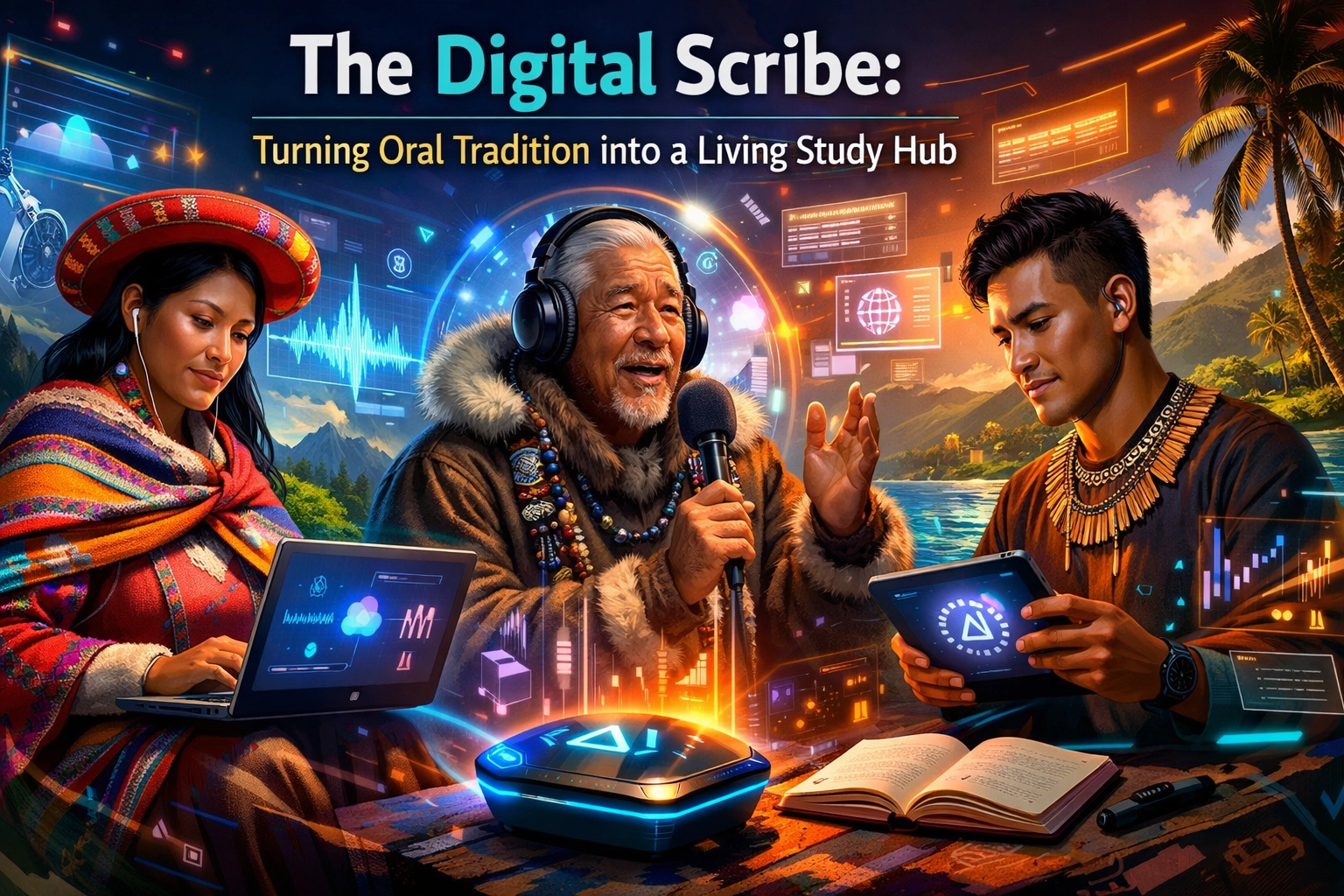
At Ejiogbe Voices, we've built something beyond a simple archive. We call it the Study Hub, a dynamic, interactive learning environment where oral tradition transforms into a searchable, study-able resource for apprentices, researchers, and cultural institutions worldwide. The Digital Scribe doesn't just record. It transcribes, indexes, annotates, and teaches, turning hours of spoken wisdom into a living laboratory for Ancestral Intelligence.
From Voice to Verse: The Challenge of Oral Learning
Traditional apprenticeship meant sitting at the feet of an elder for years, absorbing teachings through repetition, context, and embodied presence. But modern reality presents obstacles: distance, time constraints, language barriers, and the simple fact that not everyone can access these teachers directly.
Recorded audio helps, but it's a passive solution. Listening to a three-hour teaching without transcription means you can't search for a specific concept, can't revisit a single phrase without scrubbing through timestamps, and can't study vocabulary systematically. The wisdom remains locked inside linear playback, precious, but not pedagogically powerful.
We needed something different. Something that honored the voice while unlocking its educational potential.

Multi-Engine Transcription: Precision Meets Cultural Context
The foundation of our Study Hub begins with transcription, but not the kind you're used to. Standard speech-to-text tools often stumble over non-English languages, spiritual terminology, regional accents, and code-switching between sacred and vernacular speech.
Our multi-engine transcription system addresses this by running audio through specialized models trained on diverse linguistic datasets. Rather than relying on a single algorithm, we synthesize outputs from multiple transcription engines, each bringing different strengths to the table. One excels at tonal languages. Another handles dialectical variation. A third captures technical or ceremonial vocabulary with greater accuracy.
The result? Transcripts that respect the nuance of how elders actually speak, complete with proverbs, invocations, and culturally specific terms that would otherwise be mangled or omitted entirely.
Time-Synced Playback: Word-by-Word Immersion
Here's where the Study Hub becomes truly interactive. Every transcribed word is linked to its precise moment in the audio recording. Click any phrase in the transcript, and the audio jumps directly to that point. Listen to the audio, and the text highlights word-by-word in real time, following along like a living subtitle track.
This time-synced playback transforms passive listening into active study. Apprentices can:
- Replay specific sentences to catch pronunciation and intonation
- Compare how an elder says a word versus how it appears in text
- Study at their own pace, toggling between reading and listening
- Navigate directly to key teachings without losing hours to manual searching
For researchers analyzing speech patterns, ritual language, or oral performance styles, this feature is invaluable. For students learning a heritage language, it's the difference between guessing and truly understanding.

Dynamic Dictionaries: Building Vocabulary from Wisdom
Oral traditions are dense with specialized vocabulary, plant names, ritual terms, genealogical references, proverbs, and code words understood only within a cultural context. Standard dictionaries can't capture this depth.
Our dynamic dictionaries grow organically from the content itself. As transcripts are processed, the system identifies recurring terms, phrases, and concepts, cataloging them with contextual definitions. Elders, contributors, and community members can then annotate these entries, adding:
- Cultural context and usage notes
- Translations and pronunciation guides
- Related concepts and cross-references
- Visual or audio examples where applicable
Over time, these dictionaries become living lexicons of ancestral knowledge, searchable, shareable, and constantly enriched by community input. Students no longer need to interrupt an elder mid-teaching to ask for a definition. The knowledge is embedded, accessible, and always growing.
The AI Learning Lab: From Passive Archive to Active Education
This is where the Study Hub reveals its full pedagogical power. The AI Learning Lab takes transcribed teachings and transforms them into structured learning tools:
Flashcards
Key terms, phrases, and concepts are automatically extracted and converted into digital flashcards. Students can drill vocabulary, test their recall of proverbs, or memorize ritual sequences, all drawn directly from the elder's own words.
Quizzes
Comprehension quizzes are generated based on the content of each teaching, allowing learners to assess their understanding. Did you catch the significance of that plant name? Can you recall the steps in that ceremony? The quiz adapts to what was actually taught, not some generic curriculum.

Lesson Plans
For educators and cultural institutions, the AI Learning Lab can scaffold entire lesson plans around recorded teachings. A three-hour session on herbal medicine becomes a structured course with objectives, activities, discussion prompts, and assessment tools, all anchored in the elder's original voice and wisdom.
This isn't about replacing human teaching. It's about extending it, making sure that every hour an elder dedicates to recording becomes infinitely reusable, endlessly study-able, and accessible to learners who may never meet that teacher in person.
Infrastructure for Ancestral Intelligence
The Study Hub is not a standalone feature, it's a cornerstone of what we call Ancestral Intelligence. This is a framework for building AI systems that respect lineage, honor oral tradition, and serve communities rather than extract from them.
Traditional AI often treats cultural knowledge as raw data to be scraped and commodified. Ancestral Intelligence flips that model. It treats elders as teachers, recordings as sacred texts, and learners as apprentices in a continuous lineage. The tools we build, transcription, dictionaries, quizzes, exist to strengthen that chain, not to replace it.
Every feature in the Study Hub asks the same question: Does this help the next generation learn what the last generation knew? If the answer is yes, we build it. If not, we don't.
For Individuals and Institutions Alike
The Study Hub scales. Whether you're a single apprentice studying your grandmother's prayers or a university archiving hundreds of hours of field recordings, the platform adapts:
For Individuals:
- Study family recordings at your own pace
- Build personal dictionaries of heritage language
- Create custom flashcards from any teaching
- Track your learning progress over time
For Institutions:
- Catalog and transcribe entire oral archives
- Generate curriculum materials for language and culture courses
- Provide researchers with searchable, annotated datasets
- Share teachings publicly or restrict access based on cultural protocols
Cultural centers, universities, language revitalization programs, and diaspora communities are already using the Study Hub to transform static audio collections into vibrant learning ecosystems. The wisdom doesn't just sit in a server: it teaches.

Searchable, Study-able, Sacred
Here's the transformation at its simplest: an elder records a teaching. The Digital Scribe transcribes it with cultural precision. The transcript syncs word-by-word with the audio. Key terms are cataloged in a dynamic dictionary. The AI Learning Lab generates flashcards, quizzes, and lesson plans. Suddenly, what was once a three-hour audio file is now a searchable, study-able knowledge system: and it still carries the elder's voice, their cadence, their spirit.
This is not digitization for digitization's sake. It's pedagogical infrastructure built for communities that have always learned through listening, but now need tools that bridge oral and written, analog and digital, past and future.
The Living Archive
Unlike static archives that simply store recordings, the Study Hub is alive. It grows as more content is added. It improves as dictionaries are annotated. It adapts as learners engage and educators refine lesson plans. The Digital Scribe doesn't freeze tradition in time: it ensures tradition continues to teach.
Visit our updates page to see the latest features being added to the Study Hub, or explore our documentation to learn how your community can start building its own learning environment.
Because oral tradition was never meant to be passive. It was always meant to be studied, questioned, memorized, practiced, and passed on. The Digital Scribe simply ensures that process doesn't end when the recording stops. It's just beginning.